A Bridge to You and Me, of Purest Stone


This is the Preface for my book Grace Be With You. The Preface is about the gravitational power of story that connects us. The book is a compilation of my stories, encouraging quotes and poems, and everyday encounters from the road to the hospital to cafes and gas stations. Be blessed, dear friends.

There’s an old Star Trek episode where a particular alien species, the Tamarians, can only communicate in images and allegories. As the helpful android, Lt. Commander Data, puts it:

“Their ability to abstract is highly unusual. They seem to communicate through narrative imagery, a reference to the individuals and places which appear in their mytho-historical accounts.”

This strange constraint plays out to amusing fashion throughout the episode, as each party is frustrated by their miscommunication, and the tension nearly boils over into a knife-fight and all-out war (maybe your idea of amusement is different than mine). By the end, one of the Tamarians sacrifices himself in order to create a heroic narrative that both his people and the Federation can understand. It succeeds; this act of nobility becomes the bridge towards peace. The great Captain Picard realizes, “The Tamarian was willing to risk all of us, just for the hope of communication—connection.”

We’re not much different than the Tamarians. We risk the friction of our jagged edges to connect, not merely by formulas or flowcharts, but by a sloppy crawl through our shared, lived-in journey. We crave a common vocabulary beyond the heavy anvils of prose, crafted from imagination and our unified experiences.

Stories contain power because they seem to unveil secrets that have long been muddled, as if we’re unearthing lost royal treasure. But more than that, stories are a connective tissue, bringing us together by the longing and landing of a resolution.

Since a narrative thrust is essentially driven by an unresolved tension, with unassailable obstacles besetting a goal on every side, we discover in them the depth of our courage and cowardice, and we find out how to be. We find what we’re meant to look like.

We find, perhaps unwillingly, that we are not always the heroes, but in need of rescue: because we’re so often the cause of our own tension. And this is what puts us in the same boat, the same battle. The best stories require first an examination of our limitations, and then a cooperation as equals, through a slow-burning realization that we are not opposed to one another, but can reach the same goals with a little spunk and ingenuity. From Star Wars to The Karate Kid to The Lord of the Rings to Up, from the Epic of Gilgamesh to the Odyssey to a genie in a bottle, these are tales told side-by-side. We find we are fellow travelers, not so different, really, with a universal desire for shalom, a harmony—and we can’t get there alone. Heroes cannot fly solo, and villains are not beyond change.

Stories and symbols have a way of disarming us, too, getting to the inside of the matter with gentle precision. Propositions are a bit like bricks and beams: necessary for the foundation, but soon rigid and inflexible. Narratives and metaphors have a dynamic of growth to them, like seeds pushing through the dirt into the sun, and they give breath. Or maybe, as one theologian said, they are windows that light up the house and give it air. It’s why Nathan the prophet did not approach David with lectures and bullet points—”Three reasons that adultery and murder are bad!”—but instead with the innocent story of a poor man and his ewe lamb, ending on a twist that David could not negotiate. It forced David to rise from the dirt, into light.

Jesus himself spoke in parables with great aplomb, from mustard seeds and millstones to swords and sparrows to wedding feasts and rebel-runaways. Jesus’s disciples often had trouble deciphering his parables, which Jesus seemed to deliberately obscure at times—but ultimately, the parables were pointing to a future work on a cross and in a tomb. His stories pointed to his heart, and his heart sculpted the greatest story of them all: a final sacrifice to bring us peace with God and one another. He spoke of rescuing us, because we could not do that on our own. We were never meant to.

Only Jesus could become our bridge of peace, our shalom. And this kind of love is not merely the royal treasure, but the very purest stone from which all treasures are made.

The following pages are much like rotating the facets of such a jewel, pointing to the pulse of the galaxy-sculptor. These stories and poems and thoughts are chiseled by joy, sorrow, failure—and the great love that has cast a shadow on them all.

My hope is that we meet somewhere between the words, to connect, because I believe this is the truest stuff of life. Stories help us to mesh in this tapestry, that in our overlap, we’d find strength hand in hand. I’m excited. I’ll see you there.

J.S. Park // Grace Be With You


Photo at top by sonlight972, used with permission.

Scared of Love and Scared of God: What Do I Do?

Anonymous asked a question:

What do I do if I’m scared of love, especially from God?

Dear friend, I would say that you’re probably describing the entire human condition and the greatest fight of our lives.

One of the hardest battles we will ever face is to truly, fully, absolutely believe we are loved. So you’re definitely not alone in this fear. It’s this very fear that drives us to seek approval in illegitimate ways from sex, money, reputation, corporate greed, racial superiority, and a million other terrible stories throughout history.

The devil dropped two lies in the beginning to trick us, and the second lie was essentially, “Isn’t God holding back?” when Eve wondered if she should get the fruit off the tree (the first lie was, “Did God really say that?” to get us to doubt God’s truth). In other words, Satan got us with, “Does God really love you?” And that’s a lie we’ve been wrestling with ever since.

The fear of love is natural, but I really do hope you’ll find good people who will demonstrate God’s love to you. One of my favorite Bible verses is 1 John 4:12, which says, “No one has ever seen God; but if we love one another, God lives in us and his love is made complete in us.” That means we see the love of God when we experience the love of His people. There’s no shame in finding divine connection through human connection.

Continue reading “Scared of Love and Scared of God: What Do I Do?”

What Are Some Legitimately Good Christian Movies & TV Shows? 15 Quick Recommendations

Anonymous asked a question:

I’m sorry for the rant, I know it’s a common complaint. But there has to be a reason it’s a common complaint. I can’t tag on “Christian” music too much because it boasts a lot of great stuff, but Christian films are really slacking besides like 5. Idk. Do you have any recommendations?

Hey dear friend, I definitely believe that you’re not ranting. I’ve written on the topic of Christian art and its mediocrity before here.

My suspicion is that Christians are expected to “show grace and forgiveness,” so this somehow gets misapplied to Christians creating subpar art. There’s quite a lot of sloppy Christian niche-entertainment that gets away with mediocre production under the label of “Jesus,” when there was a time that Christians were the most celebrated of inventors, composers, artists, and musicians of their time. While I’m all for independent artists paving their way through the industry, I think it’s unfair to slip under a critical radar with the excuse, “It’s Christian, so it’s okay if it’s a little messy.” No, not when it’s unprofessional and pandering.

Saying that art is Christian doesn’t make it Christian, and there’s some “non-Christian” art that points to God more than so-called Christian art ever could.

Continue reading “What Are Some Legitimately Good Christian Movies & TV Shows? 15 Quick Recommendations”

The Church in the Real World.


I get a little bummed out by churches that are only designed for insiders without considering the actualities of the real world, when every sermon and service uses an exclusive buzzword language to measure Christians by getting “wrecked” and “on fire” all the time. Really though, a lot of that talk is an agenda to recruit free volunteers for perpetuating church programs, or it’s passive-aggressive flexing by the pastor to look better than those “other Christians” down the street. That might be church business, but it ain’t God’s business.

People who attend church also have hospital bills and rush hour and work stress and family troubles, and they’re mostly just trying to get through the day without falling apart at the seams. They need a refuge, a safe haven, a sanctuary, a holy ground to encounter glory. They need to know how faith can operate in a fractured, fallen world — and no, not all of them want to be pastors or missionaries or deacons. I don’t think our biggest concerns are false theology and church methodology and “you better have an authentic faith with everything you got.” That’s all important stuff, but Jesus doesn’t make us jump through those hoops to meet him. Only people do that.

Jesus is doing a work that’s bigger than our doctrinal squabbles and our ministry bubbles. He’s come to inaugurate a Kingdom. And he meets us where we are to bring that sort of healing, right in the dirt and grit of our very worst. We need him most between the back door of the church to the front seat of the car, in the real world again, in that uncertain space from Monday to Saturday, when the pressure is on. This is where Jesus does his best work. This is where we get to work, too.

— J.S.


I Hate My Life and Myself and I Want to Die: What Do I Do?

Anonymous asked a question:

I find myself begging God for death almost every day. On the days I don’t, I’m numb & I’m just going through the day hating my life. It’s hard not to compare myself to the rest of my peers who are doing great things & I’m just here painfully existing. My 1st degree didn’t get me any jobs in my state, so I’m stuck working a job that doesn’t pay much to help me afford a secondary degree. I know I’m not the only person suffering from the effects of a rigged economy, but how am I to remain positive?

Hey dear friend, I’m very sorry for all that’s happening. I want to tell you that you’re not alone, and that I got a ton of love for you, and I’m certain that everyone here does, too. I’m praying for you right now, even as I write this.

I have to say this too: If you feel like you’re in danger of hurting yourself at all, please go talk with a trusted friend and talk these things out. Please consider getting with a qualified, certified person who can help. I hope and pray that you won’t make any big rash decisions during a downward spiral, and that you’d first talk it over with someone, face-to-face, even if that means forcing yourself to get there and giving your decision-making power to someone else, however long it takes. Just talking about it can be enough sometimes to take another step.

I want to share that I’ve wrestled with depression for as long as I can remember, and I did attempt suicide over ten years ago (half a bottle of pills, I lost 13 lbs. in three days, and was Baker Act’ed into an institution). I get into self-loathing loops of hopelessness all the time, like someone has just yanked my guts through my chest in one fell swoop and I’m crumpled over with completely cold apathy, not caring about a thing. Several years ago, I had a complete breakdown at my workplace from the work environment (in which the boss laughed it off), and a year later, I was fired from that very same job. Co-workers got way ahead of me, which was absolutely fine, but many of the people that I called “friends” deserted me. Life is unfair. It can be cruel. Things don’t always work out.

The reality is, our dreams get crushed, and people will leave or cheat or abuse us, and our perseverance doesn’t always pay off. Prayers can go unanswered for a lifetime. I sit with some hospital patients who don’t want to leave because their life outside is so desperately miserable. Even a perfectly crafted life can come crashing down in a second, when external forces suddenly strip us of all we have built. Most of us are not prepared for how harsh and brutal that life can be, because no one gives the hard talk about what it’s really like.

Continue reading “I Hate My Life and Myself and I Want to Die: What Do I Do?”

How Do You Keep Believing This Jesus Bulls__t?

Anonymous asked a question:

How do you believe when, pardon my french, you’ve been taught that everything about Jesus is bulls__t? I’d love to believe it, I really want to, it’s just hard to when you’ve been taught the opposite. Do I have to unlearn the foundation of my education?

Hey dear friend, to be truthful: you’re in the best place possible, with the single biggest advantage over someone who’s been raised in the church.

You get to be in a place where you’re starting with a hugely skeptical eye towards Christianity, which means that if God starts to lean in on you, you will have already encountered your biggest questions about faith. If only every Christian honestly encountered every doubt and argument and problem with Christian theology, with complete openness and abandon, then we might see how deep Christianity can really go.

Please do not think you have to unlearn anything you’ve learned. I suggest the opposite. Use your education to fairly weigh every piece of evidence you encounter. Keep digging into Christianity down to the bottom, to see that it’s both true and fulfilling, that it’s both intellectually coherent and existentially satisfying.

Continue reading “How Do You Keep Believing This Jesus Bulls__t?”

Is It Really a Sin to Worry?

Photo and art by Jodi Sparber

Anonymous asked a question:

My pastor has given two lessons on why worry is a sin and how to stop it. Is it really a sin if worry is somewhat out of your control? I have OCD and anxiety, and worry is at the root of both. Am I simply not trusting God enough? Am I a bad Christian?

Hey dear friend, I got a ton of love you. We’re fellow worriers! That doesn’t make you a bad Christian, just an honest one.

First things first: The Bible is very clear that we don’t need to be afraid or to worry. Every time an angel shows up in Scripture, the angel is always like, “Don’t be afraid!” Which is hilarious, because if an angel tore my roof off and yelled something in Hebrew at me, I would need to steam clean my floors. Twice.

So yes, your pastor is right, in that worry is a sin that will hurt you, especially when it gets carried away and exaggerates your fears into unrealistic over-phobias. It certainly doesn’t “help to worry.” It tries to conform reality to our expectations, but the more we try to bend the results, the more that we ourselves will break.

Yet on the other hand, God knows we’re going to worry. Some of us will worry more than others. Especially in your case, in which you deal with anxiety, and in my case, in which I deal with depression, we’re going to have an uphill battle. God doesn’t work in “ideals” all the time, but works in the actual gray-space of who-we-are. So while it would be very ideal if we never worried and always trusted Him, and that “not worrying” would be the healthiest things for us, it’s just not going to happen.

Continue reading “Is It Really a Sin to Worry?”

Which Books of the Bible Do I Start First?

shadytyrone asked a question:

For someone brand new to the faith, what is a good chapter of the Bible to start reading?

Hey dear friend, great question. I think it really depends on your learning style, but I can recommend a few ideas:

– The Book of John is almost always the best place to start. It has a ton of theology and shows specifically what Jesus came to do on the earth. It elaborates on seven miracles by Jesus in ascending order of power (starting with turning water into wine, ending with Jesus raising someone from the dead), and suddenly Jesus gets a hit contract on him because he’s considered too powerful. Jesus gives a few sermons before he dies, sort of like “last words,” and there’s a detailed account of Jesus’s activity after he jumps out of the grave. I also like the Book of Mark, as it’s the “action gospel” and moves very quickly through Jesus’s life, like a Robert Ludlum novel.

Continue reading “Which Books of the Bible Do I Start First?”

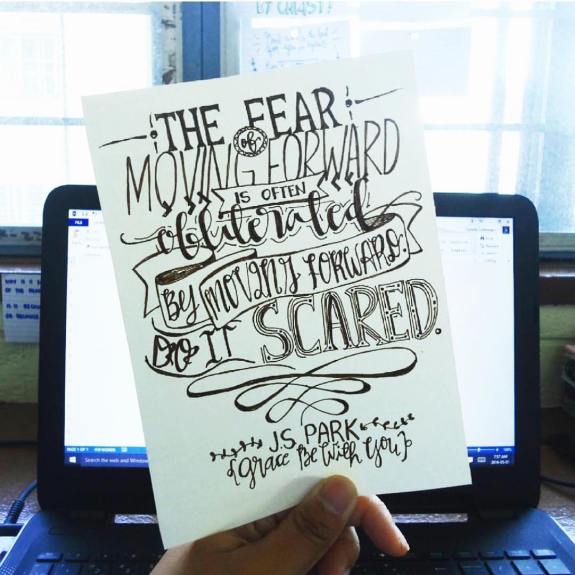
Overcoming the Fear of Moving Forward.


The fear of moving forward is often obliterated by moving forward. Do it scared.
J.S.


Art by Pam Carbungco

What the Bible Says.


Scripture isn’t supposed to make you a jerk. It doesn’t matter if “the Bible says.” If you’re a jerk about it, you don’t actually care what the Bible says.
J.S.


Art by 1of1doodles

Hang In There.

hang in there world not final home worshipgifs


Hang in there. This world is not our final home. Do something; move on.
J.S.


Photo by worshipgifs

Pulpit Hero.

Photo by evcpics, CC BY 2.0


I get a little nervous when a preacher only preaches his hero-stories, when he seems to be his own marketing guy saying, “This is what Jesus does, and if you do what I’m doing, you’ll make it.”

But I always lean in when the pastor tells me about his failures. When he’s really for real. That time he blew up on someone in traffic. When he lost it with his family. When he quietly refused to help a homeless guy. His sudden shopping spree. Those seasons when he stopped praying and reading the Bible because he was so jaded and burnt out. His frustrations with the church culture, not in a sneering way that points out any one person, but really grieving over our collective lack of passion. The times when he doubted himself, when he doubted God.

It doesn’t mean we imitate all of the above, and pastors are held to a high bar for a reason: but I don’t want the act. I’d love it for a pastor to rip the mic and tell us how much he’s hurting right now and how much he still trusts Jesus to get him through all this and even tell us he’s barely holding on by a thread of his beat-up faith. Hero-stories are okay, but I want to know we’re in this uphill fight together.

Then the pastor isn’t some guy “up there” as if we’re “down here,” and it makes us a little more human too, and this points to our need for Jesus and for grace. The pulpit becomes a haven instead of a tower, a manger instead of a throne. I want to meet there inside our mess-ups, where Jesus is, the real hero of this story. With Him, we’ll make it down here.

J.S.

The Story of Us.

Frederick Buechner instagram story


“My assumption is that the story of any one of us is in some measure the story of us all.”
Frederick Buechner

Breaking Through Jealousy: Passing the Fire to the One Ahead

I’ve learned that the quickest thing that kills friendships is jealousy. Sometimes it’s a slow death; jealous people can act loving for a lifetime, but they waste their lives comparing to each other instead of helping each other out.

Jealousy can cut short the empowering work of friendship and all the joy and vision it brings forth.

I have two choices: I’m either your cheerleader or the loop of condemnation in your head. And I know which one I prefer to be around.

I just hate what jealousy does to people. The worst, most cutting words come from envy. Families, churches, and businesses rot from the inside. It causes even the nicest people to horde their own talents and hold others back, and they’d rather snuff out the torch then pass it on to a new generation. It turns us into small, shrewish versions of ourselves.

I’ve lost friends this way, and you can’t really call someone out on jealousy. It feels arrogant, and no one would confirm such a dirty accusation. No one confesses it, either. In my years of ministry, I’ve never heard someone tell me, “I’m just a jealous, insecure hater.” Have you ever said that in the mirror? Me, neither. You’ll hear about murder and drugs in the confession booth before envy. It blinds us into denial.

I’ve seen a lot of good friends get blown up when envy got a foothold. One friend would get successful in their field while the other stayed unseen, and the unseen friend starts to feel like their famous friend owes them. There’s a lot of fist-shaking at God and self-directed anger. It’s nasty stuff.

Preparation is half the battle. If you can name the demon, you have a better chance of beating it. Fighting sin means expecting the monster, and then tackling it in the doorway. It means laying down the worldly weapon to pick up a weapon of grace.

Continue reading “Breaking Through Jealousy: Passing the Fire to the One Ahead”

Where Love Can Go.

Real love meets best mess worshipgifs JS Park


Real love doesn’t meet you at your best.
It meets you in your mess.
J.S.


Photo from worshipgifs

5 Ways to Diligently Discern All the Good and Bad “Christian Advice”

There’s a ton of Christianese literature out there, and some of it’s bad, bad, bad advice.

In my best movie trailer voice: In a world of Christian bestsellers, blogs, podcasts, and instagrams with Bible verses on ocean wallpaper, who are all coincidentally on an “authentic relevant struggling faith journey,” one ESV-carrying Christian millennial rises above the handlettering and “I’m not like those Pharisees” YouTube channels to authentically struggle with discerning what’s theologically sound and really works in the mess of real life.

But seriously: witty snark and pretty prose in bite-sized blog posts (like this one) don’t ever mean credibility. We really do need to know what “works in the mess of real life.” And it’s not going to be stitched-up quotes and here’s-what-I-would-do sort of fluff that sounds ideal but doesn’t work down here in the dirt.

I don’t claim to know any better on this. In fact, please don’t trust me, because I will let you down and inevitably disappoint you. Bloggers are not your counselors, no matter how flowery and fluffy their words. And your favorite “Christian celebrity” with the million followers might not be as inspirational as his tweets and t-shirts in his Etsy store.

Christians are called to discern everything we read, especially from sources that claim they’re fellow Christians. Here are a few questions to consider when we run into any kind of advice.

1) Where is it coming from? Says who?

It’s easy to start a blog and start preaching way further than our lives have actually lived. So much of Christian advice is idealistic guess-work that hasn’t been field-tested or approved by experience, much less cited or researched. In fact, a lot of it’s packaged to get hits and go viral, instead of actually caring about the real person it claims to help.

This will sound mean, but a lot of the shrill imperatives we see in blogs and books are from well-intentioned, untested upstarts who vicariously uphold an image that isn’t really them, either to compensate for their own shortcomings or to grab those precious followers. I only know this because I started that way, and I regress easily. Social media, for all its benefits, has made pedestal preachers of us all. I’d much rather someone tell me how it really is, with candid humble honesty, instead of how it “should be,” and to learn from their mistakes rather than get imprisoned by an impossible parameter—a paremeter, by the way, which is hardly practiced by the ones preaching it.

A suggestion: Check their bio. This isn’t to judge them or to assign value, but to see what they’ve actually been through. This also doesn’t mean that “youth” can’t say wise things, or that only experienced elders have knowledge. But rather, it’s to ask: What makes this person credible in this particular subject? What have they seen and who have they been around? How have their experiences informed their faith? And certainly there are those who have hardly been through much but can still write wonderful things, beyond their years, and it’s worth celebrating the exceptionally rare gift of youthful wisdom.

2) Is it reactionary?

I love snark and sass, but some advice is just a childish temper tantrum that caters to pseudo-outrage and preaches to a choir in an ivory tower. I call it Popular Discontent: find something wrong, multiply the fear and anger, call out some names, and you’re instantly viral. Also include, “I’m not like them, we’re like us, I’m protecting you, and everything is terrible and evil and I miss the good old days and these young people don’t even know.” Hashtag: Get off my lawn.

Another thing is that contrary to the cool postmodern professor, Christianity always challenges you to think for yourself. Discernment also means investigating every voice and giving it a fair hearing, no matter how dissenting, unpopular, or critical. But a church steeped in reactionary backlash tends to say, “My way is better than theirs and it’s the only way,” which becomes an echo-chamber cult of self-congratulatory chest-bumps.

A suggestion: This one’s tricky, because we do need to call out things that are obviously harmful, and I definitely sympathize with people who have been extremely hurt and must react as loudly as possible. The problem is building an entire platform on what you’re against instead of what you’re for. We go too far the other way, and it’s not hard to find something wrong with everything. Cynicism is easy mode. And everyone can tell when someone is secretly barking at a bone to pick or beating a dead hobby-horse. It’s a constant “throwing them under-the-bus.” I have to catch myself on that all the time (and I’m trying my darn hardest to balance that here). If the tone is passive-aggressive instead of pro-active, I let myself out. It’s a balancing act to be fair and firm, which leads us to—

Continue reading “5 Ways to Diligently Discern All the Good and Bad “Christian Advice””

Writing Them In Instead of Writing Them Off: A Grand Vision of Saul to Paul

Photo by VSP, CC BY 2.0


Hello dear friends! This is a message I preached called, Writing Them In Instead of Writing Them Off: A Grand Vision of Saul to Paul, on the story of killer Saul becoming Apostle Paul, from the perspective of his first roommate, Ananias.

I talk about how the disciple Ananias helped to turn a Christian-killing terrorist Saul into the Bible-writing healer Paul — and how God does that kind of work in us. Stream below or download directly here. I’m also on iTunes here.


Some things I talk about are: Adopting my abused dog Rosco and rehabilitating him, how an African-American musician befriended and changed a KKK leader, why I agree with the Elder Brother against the Prodigal Son, the impossibility of outgrowing your nickname and time-stamped hometown past, the one frustrating difficult person that never changes, how the back-row of punk kids at church completely humbled me, and the freedom of finally becoming the kind of person that loves no matter what.

All messages are here. Be immensely blessed and love y’all!
J.S.

From Mountain High to Valley Low: Finding an Oasis in the Darkest Desert

Photo by Lenny K, CC BY 2.0


Hello dear friends! This is a message I preached called, From Mountain High to Valley Low: Finding an Oasis in the Darkest Desert, on the story of Elijah from 1 Kings 18-19.

It’s about finding our way through discouragement, distress, and depression, and how God speaks to us in those seasons and how we speak to one another. As a lifelong sufferer of depression, this is hugely personal for me. Stream below or download directly here. I’m also on iTunes here.

Some things I talk about are: The sudden mental replay in the shower and the late-night regret twitch, the one common denial from every patient in the hospital, when you just need a hamburger and a really long nap, the hidden fear of men getting honest, the panic moment when someone sees your text messages and photos, how Yoda finally got through to Luke Skywalker, and Elijah versus depression versus the world.

All messages are here. Be immensely blessed and love y’all!
J.S.

Unchanging Heart.

heart of God unchanging changes you JS Park Instagram

The heart of God will never change no matter what you do,
and it’s His unchanging heart that changes you.
J.S.


Kindness, Kindly.

CS Lewis kindness instagram

“The worldly man treats certain people kindly because he ‘likes’ them: the Christian, trying to treat every one kindly, finds him liking more and more people as he goes on — including people he could not even have imagined himself liking at the beginning.”
C.S. Lewis