Who to Vote for If I Don’t Like Either Candidate?

Anonymous asked a question:

I have no idea what to do about the upcoming presidential election. I want to vote because I can, but I don’t see either of the options as fitting for the role. Any advice?

Hey dear friend, at the risk of alienating others: I also don’t want to vote for either candidate. I think that’s a perfectly legitimate option, all the way up to the voting booth.

Here’s the thing. An American President only has so much actual deciding power, as there are checks and balances to limit what one official can do (though of course, their policies are certainly a factor in how you vote). But my main concern is that the elected officials in any government are part of a greater social influence that describes and decides who we are as a country and a people.

I think the question that I ask is: How will my vote affect the story and direction of our country?

Continue reading “Who to Vote for If I Don’t Like Either Candidate?”

Who I’m Voting For.


I was asked about my politics. About who I’m voting for.

I don’t know who I’m voting for, but I know who I’m hoping for.

I’m hoping for a candidate who won’t use easy buzzwords and one-liners to pander to a party, who calls out who we should be, and calls us to who we could be.

I’m hoping for a candidate who actually cares, from-the-pit-of-their-stomach until their voice shakes, for black lives and cops’ lives, for teachers’ lives and adopted lives, for lives outside the four lines of a party line; for the least of these, for the working class and freshmen class and aristocrats, for shamed and blamed victims in universities; for the mentally ill, the fatherless, the lone veteran, and refugees; for majorities and minorities, those in Wall Street and on the streets, for those in need and those who lead, for the Constitution and spiritual liberties: not to accuse one to lift up the other, but to raise up without dichotomies, without looking for exceptions and squeezing into our isolated categories.

I’m hoping for a candidate who doesn’t crudely appeal to the entitled or the corporations, who doesn’t ride on young votes or legacy votes or angry votes or religious votes, who doesn’t tickle the little racist in all of us, who can pull together a unified diversity and a diversified unity, without demonizing or cartoon-villainizing a caricature of the “other side,” who reaches across the divide but without compromise.

I’m hoping for a candidate who listens more than talks, who hands the microphone across the stand, who questions more than lectures, who doesn’t condescend but descends where I am.

I’m hoping for a candidate who isn’t poaching for my vote by the end results of a focus group, who might disagree with me but still tells me the total truth.

I’m hoping for a candidate who won’t play zero sum, who won’t falsely promise a full pocket by reaching into my other one.

What I’m hoping for is impossible and illogical, and I remain cynical. I might as well be talking about Jesus, and look what they did to him: his cross became his pedestal.

I’m probably asking for too much — but maybe we haven’t been asking for enough: because enough would be someone who had the guts to say, “It’s not them or you, it’s them with us.”

Because who I’m voting for won’t matter

unless we figure out what matters.

I got a hope bigger than politics and polls,

and that’s the hope that we know there’s better and more.

Call me an idealist, or naive, or romantic, or say I’m avoiding the question: but if we can’t relinquish our verbal weapons, we’ll have nothing left past the aftermath of an election.

And really, all these changes that I want to see,

it doesn’t start with a vote, but a wild hope in we.

These changes, really,

they have to start with me.

All this starts

with you and me.

J.S.

Self-Affirming Blog Bias: The Danger of Reinforcing Misinformation & Inaction from Isolated Viral Awareness

One of the problems with circular echo chambers like Tumblr, Facebook, WordPress, or Twitter is that we mostly follow the voices that confirm our own preconceived beliefs while shutting down the evidence that runs counter to our bias. We’ve locked ourselves up in self-preaching choirs and impregnable ivory towers. Our life philosophy is then reinforced by the buzzwords and bloggers we want to hear, and we demonize a phantom enemy that isn’t anything close to a real person or idea, neglecting to engage with the real world and the very real issues at hand.

On a long enough timeline, you and I become radicalized into a new kind of fanaticism, devoted to our out-of-touch, fact-devoid, isolated cages. With so many actual injustices abounding that need solutions, our faceless debating hijacks the limelight and resources from the deficit of the people we claim to be rooting for.

This is a vicious cycle that continually perpetuates misinformation disguised in pieces of truth. Some of these truths are necessary, which is all the more reason it’s a travesty that they’re buried under a blind clicking frenzy. We buy into an aggregated “fringe platform” of like-minded ideologies that only feeds itself, like the mythical dragon ouroboros that chokes on its own tail, which only attracts people who already agree and don’t want to be challenged. This common delusion appeals to our basest urge for socialization and vicariously victimizing ourselves on behalf of someone else’s “inspirational tragedy.” Never mind that it’s the other person’s everyday life and only your two second click of a like button.

It gives us a self-righteous tingle to think, “I have the insider knowledge and you don’t.” It’s a shiny trophy of “online education” that will swell your ego and high-five the hive-mind, but it does nothing and goes nowhere and has no real chance of dialogue.

If this makes you mad, then it might be too late for you. I understand though: we hate the possibility of being on the “wrong side” and “losing face.” Being rejected by your group of yes-men or criticized by the opposite side feels like death, and we either self-destruct or destroy others. And to actually work to understand the issue? It’s too hard. We’re in love with trying to change the world by looking like we’re trying to change it, with pretty text on a screen.

Continue reading “Self-Affirming Blog Bias: The Danger of Reinforcing Misinformation & Inaction from Isolated Viral Awareness”

YouTube: “We Can Disagree, And That’s Okay”

http://www.youtube.com/watch?v=dEmRuv5lEdg


Here’s my first YouTube video, called “We Can Disagree, And That’s Okay.”

You like cats AND dogs? That’s okay.
You’re into science AND religion? That’s okay.
Single and not looking? That’s okay.
Introverted or extroverted? That’s okay.
You prefer romantic-comedy Ryan Gosling over Oscar-serious Ryan Gosling? That’s okay.
Republican or Democrat or neither? That’s okay.
Cheese on your ramen noodles? Well … maybe not okay.

Please subscribe to my channel and love y’all!

— J.S.


YouTube logo


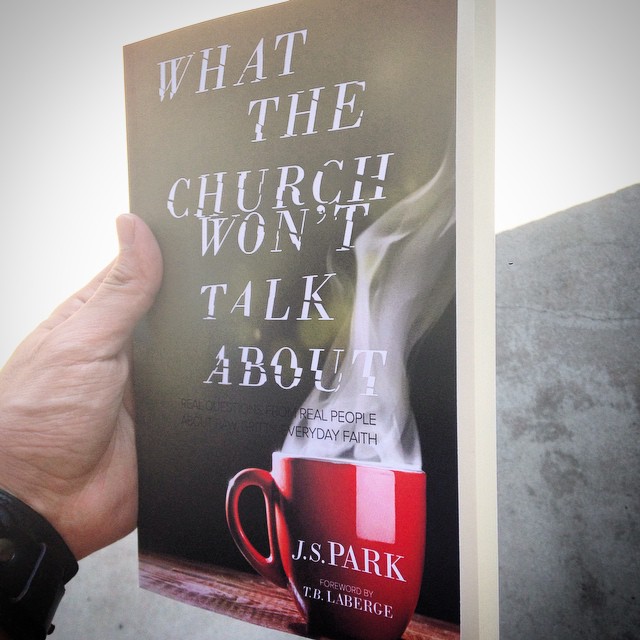
My Own Book Came In The Mail.

My book


So I got my own book. 🙂

— J.S.


Crazy Blessed: Thank You, Dear Friends.

Best Seller Hot Release Devotionals

On the Amazon Christian Kindle List for Devotionals.


Caleb

My friend Caleb sent this to me. Honored and humbled to be next to the great Dietrich Bonhoeffer, who I also quoted in my book.


LB soap writers block gift

My wonderful friend Lauren from the blog Yesdarlingido sent me this to celebrate the book release.


— J.S.

Get the e-book on Amazon here!

And now in paperback here!


Triumphalist Self-Affirming Theology: “God Is On My Side, So Screw Everyone Else!”

A lot of times I get this crazy table-flipping empowerment from Christian blogs and sermons that tell me “I’m above all this” and “You go accept yourself” and “Forget what anyone else thinks” and “They’re holding you back” and “Screw the haters!” — when underneath there’s an insidious hidden language that’s really saying, “You are God’s favorite and everyone else is just against you.”

This sort of bizarre, cult-like, categorical thinking always appeals to my flesh, and I fall for it.

I suppose I can understand it, because certainly there are a lot of haters and we’d be wise to filter out false voices.  But I think we’re often too scared to hear criticism, too lazy to discern what is right, and too prideful to consider when we’re wrong — so we toss out any “opposition” and continually affirm ourselves as the most important person in the room.  We use words like “enemy” and “strongholds” and “negativity” when just maybe God is actually trying to rebuke us from serious error.

All this egotistical theology is disguised as inspiration and it works for a few seconds. But the end result is a self-applauding, me-versus-you, superiority complex that shuts down any disagreements or honest questions.  I’ve hung out with groups like this, and I want to be gracious here: but it was always disgusting. 

Maybe I’m undermining my own point by saying so, but I really just hurt for them.  They could not see the destructive divisions they were causing.  If a sermon wasn’t up to par, then instant mockery.  If a Christian’s faith looked different at all, then immediate ridicule.  If it was a megachurch, then constant hate. 

Continue reading “Triumphalist Self-Affirming Theology: “God Is On My Side, So Screw Everyone Else!””